
Holly Springs Past Residents by Era
Past residents are best traced through sources that answer different questions. A tax parcel and deed establish the land and transfers. A reverse directory can suggest an occupant at a listed address. The census shows a household at a point in time. Permits can date work or document a named project role, but they do not prove who lived in the property. The first task is to choose the source whose date and purpose fit the period being investigated.
| Source | Years it covers | Where held | What it can show |
|---|---|---|---|
| Wake deed index and instruments | Legacy online documents from July 1785 through April 17, 2025; newer Land Records system after transition | Wake Register of Deeds | Recorded transfers, parties, book or page, legal description, and prior deed references |
| Wake deed and conveyance microfilm | 1785-1946 and later deed sequences | Olivia Raney and Wake catalog resources | Older land-record bridge and book or page research |
| Criss-cross and city directories | Years vary by title | Olivia Raney Local History | Address-to-name leads, occupations, and household notation |
| Federal census | Through 1950 under the cited 72-year release rule | NARA, library databases, and family-history services | Household snapshot and approximate ages |
| Permit records | Wake search before July 1, 2018; later town activity in CityView | Wake and Holly Springs systems | Project, work, applicant, owner, contact, and inspection clues |
A family may be visible in one source and absent in another. Renters and household members often do not appear in property records, while an owner of record may use a mailing address elsewhere. Keep those roles separate throughout the search.
Anchor Holly Springs Previous Residents to a Parcel
Begin an address history in Wake/Raleigh iMAPS. The public search accepts an address, street, owner, PIN, or Real Estate ID, also called REID. Save the situs address, current owner, PIN or REID, jurisdiction, and available parcel context. PIN or REID is often the fastest exact key. If an address does not match, the official guidance suggests trying a street abbreviation such as S and South, searching the street alone, or using the Identify function on the parcel map.
Do not turn the tax mailing address into a claim of residence. Situs is where the land lies. Mailing address is where the owner receives tax correspondence, which may be an office, trustee, estate representative, company, agent, or a home in another city. The current parcel is simply the secure starting point for tracing previous residents and past ownership.
Wake/Raleigh iMAPS is the source for the address, owner, PIN, REID, and parcel controls used to anchor a Holly Springs address.
The parcel result gives the stable identifiers needed before a name search moves into the Register of Deeds index.
Holly Springs Past Residents and Wake Deed Access
The Wake County Register of Deeds is the documentary ownership layer. Its Consolidated Real Property Index states that documents from July 1785 through April 17, 2025 remain viewable in the legacy application. A new Land Records application launched April 21, 2025. Treat those dates as a transition boundary, not as a promise that the two systems expose the same interface or every field in the same way.
For a new chain, search the current owner as grantee or grantor, apply a useful date range, and filter the documented type when appropriate: DEED, QCD, D-T, MAP, SUBN, EASMT, or another relevant notice. Open the instrument and compare the parcel or legal description with the iMAPS record. The Register's search disclaimer describes the index as a catalog-like guide and warns that spelling variations matter. Use Standard and Sounds Like, less name text, and both individual and firm search modes when a name changes.
Note: The legacy system's long date range is valuable, but a book or page, legal description, and the actual instrument remain stronger than a name hit alone.
Tracing Holly Springs Previous Residents Through Deeds
A deed chain is a backward record trail from today's parcel to prior transfers. In the index, the buyer is the grantee and the seller is the grantor. Read the instrument instead of relying only on the result list. The relevant details can include recording date, book and page, document type, PIN, legal description, seller, buyer, consideration or excise-tax information, return-to address, and a prior deed reference. The legal description is the best continuity test when a street name, number, or subdivision has changed.
- Use iMAPS to capture the current owner, PIN or REID, situs address, and legal description clues.
- Search that owner as a grantee in the deed index and locate the purchase instrument.
- Record the seller, recording date, book or page, document type, PIN, legal description, and prior deed reference.
- Search the seller as a grantee to locate the earlier acquisition, then repeat while the legal description still matches.
- When the online index is not enough, take the book or page and legal description to the Register, library microfilm, or archival deed material.
- Grantor
- The party transferring an interest in the recorded instrument, commonly the seller.
- Grantee
- The party receiving an interest, commonly the buyer.
- Chain of title
- The sequence of recorded transfers connected by the same parcel or legal description.
- Legal description
- The lot, block, plat, metes-and-bounds, or other land description that ties documents to the parcel.
A sale can be followed forward too. Search a former seller as a later grantee, but do not assume a later Wake transaction exists. A new spouse name, trust, entity, inheritance, subdivision, or move beyond the county can break the visible chain.
Holly Springs Past Residents on Microfilm
Online search is not the only Wake access channel. The library catalog describes real-estate conveyance material from 1785-1946, including RECONV microfilm sequences. Olivia Raney's local-history collection also has deed books, real-estate maps, property-tax records, newspapers, and materials that do not circulate. A book or page noted in an online result can become the bridge to a record that needs a counter or microfilm visit.
The State Library's genealogy guidance specifically points researchers toward deeds, tax lists, wills and settlements, marriages, court records, bonds, and Wake local-history collections. Ask staff which series covers the desired year rather than requesting an imagined all-residents list. Under the North Carolina Public Records Act, agencies need not create a new compilation that does not already exist.
For older parcel questions, historical maps and plats can bridge a modern address to a lot, block, subdivision, metes-and-bounds reference, creek, road, or neighboring owner description. This is especially useful where rural conveyances predate a current street number.
Holly Springs Previous Residents in Directories and Census
Ownership is only half the history. The Wills-Smith Raleigh criss-cross, Cross Reference Directory, and business or consumer titles in the Olivia Raney catalog can start with a street and number, then point to an occupant or business. Return to the alphabetical entry for occupation, employer or firm, spouse or widow notation, and other context. Each title's own abbreviation key matters because renter, resident, rooming-house, and business marks can change from one publisher to another.
Use a directory as an annual or near-annual clue and pair it with the closest decennial census. The directory gives a reporting-year address and movement context. The census gives a household snapshot and approximate ages. They are not simultaneous records. The regional shelf, publisher history, and entry-reading detail are kept in the Holly Springs city directory collections, while the use here is limited to linking an address to past residents.
- Choose the directory closest to the address date and record its title, publisher, year, and page.
- Check the reverse section for the street and number if that volume includes one.
- Read the alphabetical entry with the abbreviation key and note any household or work detail.
- Compare the nearest available census for household structure and approximate ages.
- Test conflicting address forms with deeds, tax records, plats, newspapers, and nearby-place headings.
Note: A Raleigh-area directory can omit a Holly Springs person or list a rural route, so an empty entry is not evidence that the address was vacant.
Holly Springs Past Residents in Regional Directories
The Wake catalog record for Raleigh city directories names Branson, Maloney, Polk, Hill, criss-cross, and cross-reference titles. Its regional scope is a feature and a limitation. A Holly Springs family may appear in a nearby place section, as a post-office or rural-route entry, or not at all. Search town name, street, surname, and surrounding place names before treating a directory gap as an answer.
The Wake catalog collection is the source for the directory title variants and access conditions that help connect a historical address to a past household.
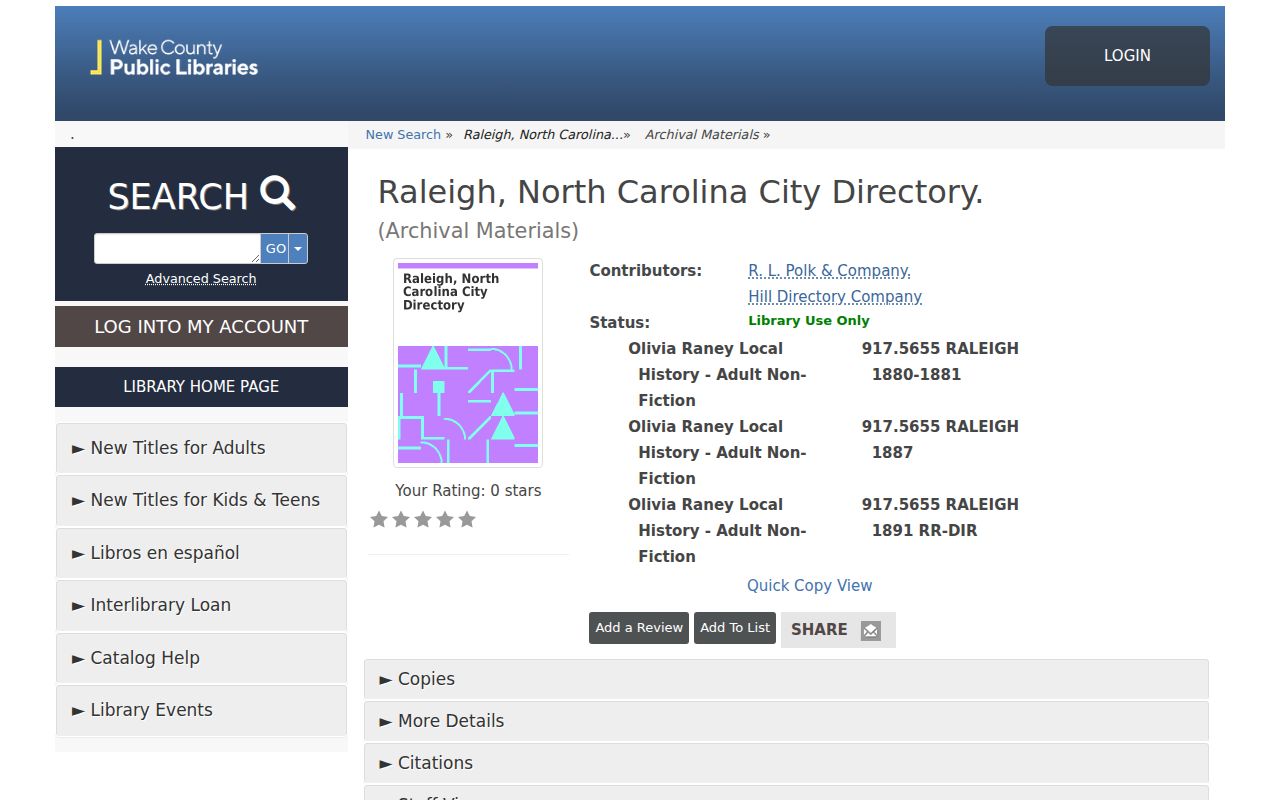
The catalog view is a reminder to record the exact volume and section used, because the city directories vary in year coverage and address tools.
Holly Springs Previous Residents and Record Gaps
The research verified digitized Raleigh Sanborn fire-insurance maps through the Library of Congress, including a Raleigh 1950 volume, but it did not verify a Holly Springs sheet. Do not label a Raleigh map as a Holly Springs house map. For a local address, use the town's history maps, plats, legal descriptions, deeds, tax records, and the library's Wake property materials instead. No official source inspected established a Holly Springs street-renumbering year, so old address changes need to be tested from the records rather than assumed.
At the end of a household trail, newspapers, obituaries, probate, and the next deed can connect a former resident to heirs or a later transfer. The Cape Fear Enterprise is a one-reel Holly Springs weekly run for 1899-1901. It can supply a date-stamped notice or local context, but it is not a complete roster and an obituary is not official proof of death.
Holly Springs Past Residents and Name Alerts
Wake's recording-alert registration is a practical monitoring tool for a name and its variations. The displayed workflow requires an email address, an Individual or Business selection, at least one monitored name, and allows additional name variations. It can help a current owner notice a new Wake recording connected to a name. It is not a substitute for reviewing the instrument in the Register of Deeds index.
The service terms expressly say the alert is informational and is not official fraud detection or title verification. For an address-history question, retain the deed's legal description, book or page, and prior reference. Those record details establish whether a notice belongs in the same chain, while an alert only signals that a name may deserve a closer look.