
Holly Springs Neighbors by Block
The most dependable neighbor question is narrow: what public record is connected to the parcels immediately around one Holly Springs address? Wake iMAPS answers the parcel and owner layer. The tax record can distinguish the physical parcel from an owner's mailing address. Permit portals show activity and named project roles. The voter lookup is a one-person confirmation source, while the town's community form is a route to an association contact rather than a directory of member households.
| Source | What it shows about a block | Access |
|---|---|---|
| Wake iMAPS parcel viewer | Address, parcel polygons, current owner, PIN, REID, and map context | Free public viewer |
| Wake property roll | Owner, situs and mailing addresses, jurisdiction, tax information | County property route |
| Register of Deeds CRPI | Recorded transfers and legal descriptions for a parcel | Official index and instruments |
| North Carolina Voter Search | Public registration details for one named person | Free lookup with redactions |
| Holly Springs neighborhood contact form | Association point of contact and communication method | Town contact channel, not a member list |
Property ownership and residency are different facts. A person listed on a parcel may be an owner, trustee, estate representative, company, or tax contact who does not live on the block.
Map Holly Springs Neighbor Parcels
Use the parcel geometry, not a subdivision label, to identify nearby lots. The iMAPS guide says a search can begin with address, street, owner, PIN, or REID. A clicked or long-pressed parcel opens property information. The same map can then be used to open the polygons that actually border or sit near the starting parcel. This method has a defined boundary and avoids guessing from a postal ZIP.
- Enter the starting address in Wake iMAPS and save the returned situs address, PIN, REID, owner name, and jurisdiction.
- Zoom to the parcel boundary and use Identify on each adjoining or nearby polygon needed for the block question.
- Record each parcel's owner name separately. Compare mailing and situs addresses instead of presuming owner occupancy.
- Open a relevant deed in the Wake CRPI only when an ownership transfer or legal description needs confirmation.
- Use the town planning maps to check the jurisdiction before assigning town responsibilities to the address.
A complete named-street sequence uses more address records and deed history. The Holly Springs street directory follows that broader method without treating the immediate block as a public household list.
Wake iMAPS supplies the map and parcel controls used to work outward from one Holly Springs address.
Each clicked polygon is a separate property record, which is more reliable than assuming all nearby homes share the same owner or jurisdiction.
Holly Springs Neighbors and ETJ
Neighbors on the same apparent block can fall under different government responsibilities near Holly Springs edges. An extraterritorial jurisdiction, known as ETJ, is outside town limits while still subject to Holly Springs zoning and building rules. The town says ETJ property does not pay town taxes and cannot vote in town elections. Wake County handles taxes, police, voting, nuisances, and stormwater there; the town handles zoning, development, and some water or sewer matters.
The town's ETJ information also says an ETJ change does not change the mailing address or ZIP code. Check the parcel's jurisdiction and the official map before using a Holly Springs label to infer municipal status.
Note: A jurisdiction label can explain why a nearby permit, police, tax, or election record routes to different offices.
Holly Springs Neighbor Voter Limits
The North Carolina Voter Search does not have a public street field. It requires first and last name, offers a middle initial and year of birth, allows Wake County selection, and requires a status choice. Use it to check an individual already linked through a lawful, independent record. It is not a tool for publishing a list of neighbors on a street.
Public registration details can include name, residence and mailing address, party affiliation, status, registration date, county, precinct, districts, and separate voter history data. Ballot choices are not public. Social Security numbers, dates of birth, driver-license numbers, some agency information, and specified military-overseas email are excluded. An ACP or other protected voter can have an address withheld.
A public-file request must be specific, lawful, and mindful of redactions. A removed or denied result is a status outcome, not evidence that someone now lives or does not live near the block.
Holly Springs Neighborhood Contacts
Holly Springs offers a neighborhood and HOA contact form so the town can share neighborhood-specific information. The form collects a neighborhood name, community type, a point of contact, leadership information, major activities, and normal communication method. It gives a useful official contact channel when a block question belongs with an association rather than a public records office.
Town community contact channel
Use the form to identify or update an association point of contact and communication method.
Association membership boundary
The town form is not a public member directory and does not publish every household in a neighborhood.
Historical community research
For older neighborhood context, Olivia Raney collections, town history, and archives are better starting points than current association contacts.
Community organizations, cemeteries, yearbooks, and local-history resources can support family or reunion research, but no complete Holly Springs membership roster was verified. Ask the organization itself about its own contact practices.
For a historic block question, use the community layer with an archive rather than treating a current contact as evidence about past residents. Olivia Raney Local History holds Raleigh-area directories, newspapers, maps, property-tax material, and Wake County Historical Society papers. The town history records a recovered early-1900s minutes book, which is a reminder that local history sometimes survives outside a searchable online catalog. Those sources provide context but do not convert association contacts into a public membership roll.
Holly Springs Neighbor Permit Activity
Permit records can place visible work or a project on a block. Wake's legacy search covers records before July 1, 2018 and accepts applicant, permit number, owner, address, and PIN. Holly Springs later planning and permit activity appears through Development Services and CityView, including public property and project information. Use the town map and parcel jurisdiction first, especially around the ETJ.
A permit applicant, contractor, or owner is connected to the work. That role does not identify every resident or prove an ongoing household connection. Code or enforcement information can also have restricted portions.
Wake's legacy permit search shows the address and PIN options useful for a historical block activity check.
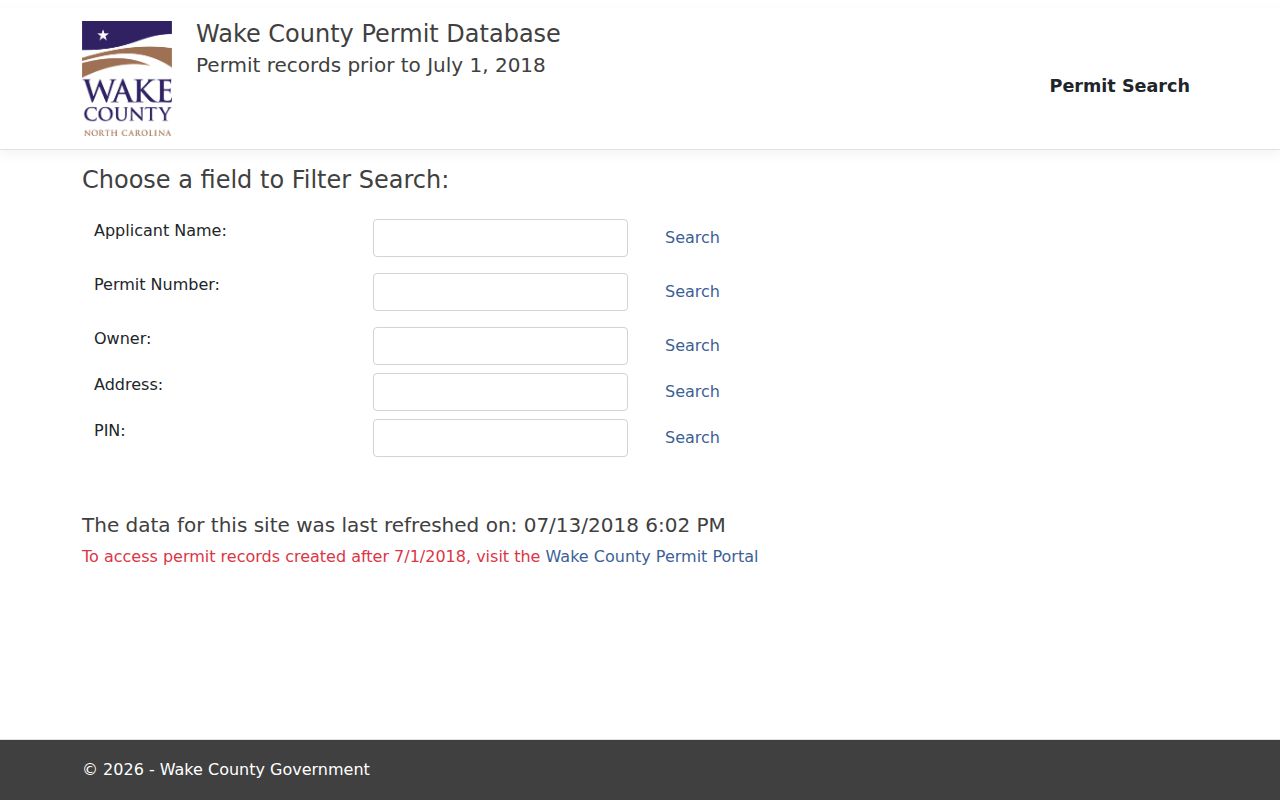
The pre-July 2018 portal and later CityView access are complementary, not interchangeable, record paths.
Holly Springs Neighbors Official Sources
Official records and commercial neighbor profiles serve different purposes. A public map, deed, voter lookup, or town contact channel identifies its custodian and scope. Commercial profiles can combine old addresses and data from different sources, which can make a same-name or former-address error look convincing. Use a custodian record to verify any fact that matters.
| Official block source | Commercial profile category | Practical difference |
|---|---|---|
| iMAPS and tax roll | Compiled address profile | Official parcel identifiers versus a potentially stale address history |
| CRPI deed instrument | Ownership summary | Recorded legal description and parties versus an abbreviated claim |
| Voter lookup | Household list | One-person public status with redactions versus uncertain household grouping |
| Town HOA contact form | Neighborhood directory | Verified contact channel versus an unverified membership assumption |
When an official source is unavailable online, contact Wake County, the town department, or the library that holds the relevant record. A request should ask for an existing record rather than a newly assembled list of neighbors.
Holly Springs Neighbor Privacy
Public parcels do not make private households public. Renters, children, household members, utility customers, delivery recipients, protected voters, and people covered by confidential court or vital-record rules may not appear in a search. North Carolina's Address Confidentiality Program lets eligible relocated survivors use a substitute address with state and local agencies, including voter registration.
North Carolina's Public Records Act applies to existing public records, with specific exemptions and redactions. It does not require a government office to create a neighborhood roster, release protected addresses, or disclose private records.
Holly Springs Neighbor Record Terms
Keeping the record labels straight protects both accuracy and privacy when looking at Holly Springs neighbors.
- PIN
- A parcel identification number used to distinguish one property from another.
- REID
- A Wake Real Estate ID that can be a fast exact search key.
- Situs
- The physical location of a parcel, separate from the tax mailing address.
- ETJ
- Town planning jurisdiction outside corporate town limits.
- Grantor and grantee
- The transferring and receiving parties named in a recorded instrument.
Note: A parcel, voter, permit, and community contact record each answer a different question, so no one should be stretched into a complete neighbor profile.
Keep the starting address, parcel identifiers, dates, and source names together so another search can be checked without relying on memory.