
Holly Springs City Directory Collections
Holly Springs does not have a verified standalone annual city-directory run. The practical collection is the Raleigh-area shelf at Olivia Raney Local History Library's Wake catalog record. It brings together early Raleigh books, later regional series, reverse directories, and related reference titles. That regional scope matters. Before suburban growth, a Holly Springs person may be indexed as a village resident, on a rural route, in a township or post-office locality, or under a nearby Apex, Fuquay-Varina, or Raleigh heading. Search more than one place name and inspect the physical volume when the catalog description is broad.
| Collection | Years held | Repository | How to use it |
|---|---|---|---|
| Branson Raleigh directories | Example: 1891 | Olivia Raney Local History | Reference collection, consult staff |
| Maloney Raleigh directories | About 1896 onward, including 1899-1900 volume 4 | Olivia Raney Local History | Reference access, confirm the volume year |
| Polk and Hill Raleigh annual volumes | 1880-1881, 1887, 1907-1935 and later runs | Olivia Raney and some DigitalNC scans | Staff consultation or online image where available |
| Wills-Smith criss-cross and cross-reference titles | Years vary | Olivia Raney Local History | Address-to-name section, consult staff |
| Cape Fear Enterprise | 1899-1901 | North Carolina State Archives microfilm | One reel, useful companion rather than a directory |
Catalog gaps and reference-only volumes are part of the record, not a reason to infer a missing household. The serial description begins in 1982, while individual holdings reach much further back. Check the actual year, publisher, and section before relying on a result.
Holly Springs on the Regional Directory Shelf
The catalog names R. L. Polk & Company and Hill Directory Company among its contributors, while title variants point to Polk, Hill's Raleigh, Maloney Directory Co., Business and Consumer Guide, and cross-reference volumes. Those aliases are search terms, not interchangeable claims of coverage. Early Raleigh books include a Branson example in 1891, Maloney titles from about 1896, and later Polk and Hill series. Holdings include verified early volumes for 1880-1881 and 1887, then many annual or near-annual books through the first half of the twentieth century, with related Wake annual volumes shown into 2004-05.
Use the library as more than a shelf. Olivia Raney's local-history service includes staff consultation, microfilm readers, archival records, property-tax material, newspapers, family histories, maps, and deed resources. The State Library genealogy guidance also routes Wake research toward local-history collections, deeds, tax lists, court records, bonds, and related sources. The Wake County Historical Society resource list helps place the library in a wider local-history network.
Note: Holly Springs listings can be scattered across rural-route and nearby-place sections, so a surname search should include several regional headings.
Holly Springs Directory Years and Publishers
Publisher changes affect both the look of a book and the meaning of its abbreviations. The verified shelf includes 1891, 1896-97, 1899-1900, 1907-08, 1909-10, 1911-12, 1913-14, 1917, 1918-19, 1919-20, 1921-23, and a nearly annual run from 1924 through 1935, followed by later Hill and Polk series. It is safer to say that the repository has these volumes than to claim an unbroken annual sequence. The catalog itself reports gaps, and the cited 1982- serial history is only a modern endpoint for the record.
| Branson | Early Raleigh production, with 1891 specifically noted in the catalog. |
|---|---|
| Maloney | Directory work from about 1896, including 1899-1900 volume 4. |
| Polk and Hill | Later series and related Wake annual volumes represented on the regional shelf. |
| Catalog serial | Begins 1982-, but should never substitute for checking an individual volume. |
For a person who disappears between years, test a spelling variation, a nearby town heading, a rural-route description, and the next available volume. A directory is a publisher's annual reporting effort, not a complete census or a title record.
Reading a Holly Springs City Directory Entry
A directory listing needs to be read as a compact historical record. The verified 1960 Hill's Raleigh scan supports a field inventory, not a claim about a particular Holly Springs household. Depending on the page and entry, capture the alphabetical person or business name, street number and street, telephone or business category where printed, spouse or household notation, occupation or firm, and any address cross-reference. Keep a page citation with each transcription. That lets another researcher find the same printed context and avoids turning a regional example into a local fact.
| Name line | Person or business as the publisher indexed it. |
|---|---|
| Street line | Street number and street, or another location description used in that volume. |
| Household notation | Spouse, widow, residence, renter, rooming-house, or similar notation when printed. |
| Work and telephone detail | Occupation, firm, category, or number where the entry contains it. |
| Cross-reference | Another address or a route into the reverse section, if the title provides one. |
- Criss-cross directory
- An address-ordered section that takes a street and number to an occupant or business.
- Householder index
- A name-focused arrangement that may identify the household contact used by the publisher.
- Abbreviation key
- The volume's own explanation of marks such as residence or renter notation. Read it before interpreting an entry.
Do not carry a key from a different publisher into the book at hand. A directory address is tied to the publisher's reporting year. It is not proof of deeded ownership and may not name every member of a household.
Holly Springs Directory Entries by Address
Wills-Smith Raleigh criss-cross, Cross Reference Directory, and business/consumer titles are the address tools on the cataloged shelf. Start with the street and number in the reverse portion, write down the occupant or business shown there, then return to the alphabetical half for the added name, occupation, firm, or spouse detail. This direction of travel is especially useful when a deed or a tax record supplies an address but not an occupant. It remains a historical lead, not a current household list.
The reverse listing should be paired with the volume's abbreviations and with its publication context. Renter or occupant marks, rooming-house labels, business suffixes, and telephone forms can change by publisher. When the address looks unfamiliar, test the legal description, old street wording, rural route, nearby town name, and the date before declaring it a mismatch. Modern parcel records belong to the Holly Springs by-street directory; the older shelf is best used here as an address-to-name bridge.
The 1960 Hill's Raleigh Scan
The DigitalNC Hill's Raleigh directory scan is a useful image-level example of how a printed entry is organized. It is not verified as a Holly Springs-named entry, and the accessible crawl did not provide stable OCR for a specific local household. Treat the scan as a Raleigh-area sample and preserve the page reference rather than copying a speculative transcription.
The Wake catalog record for the directory collection shows the regional publishers, year clues, and criss-cross aliases that guide a shelf search.
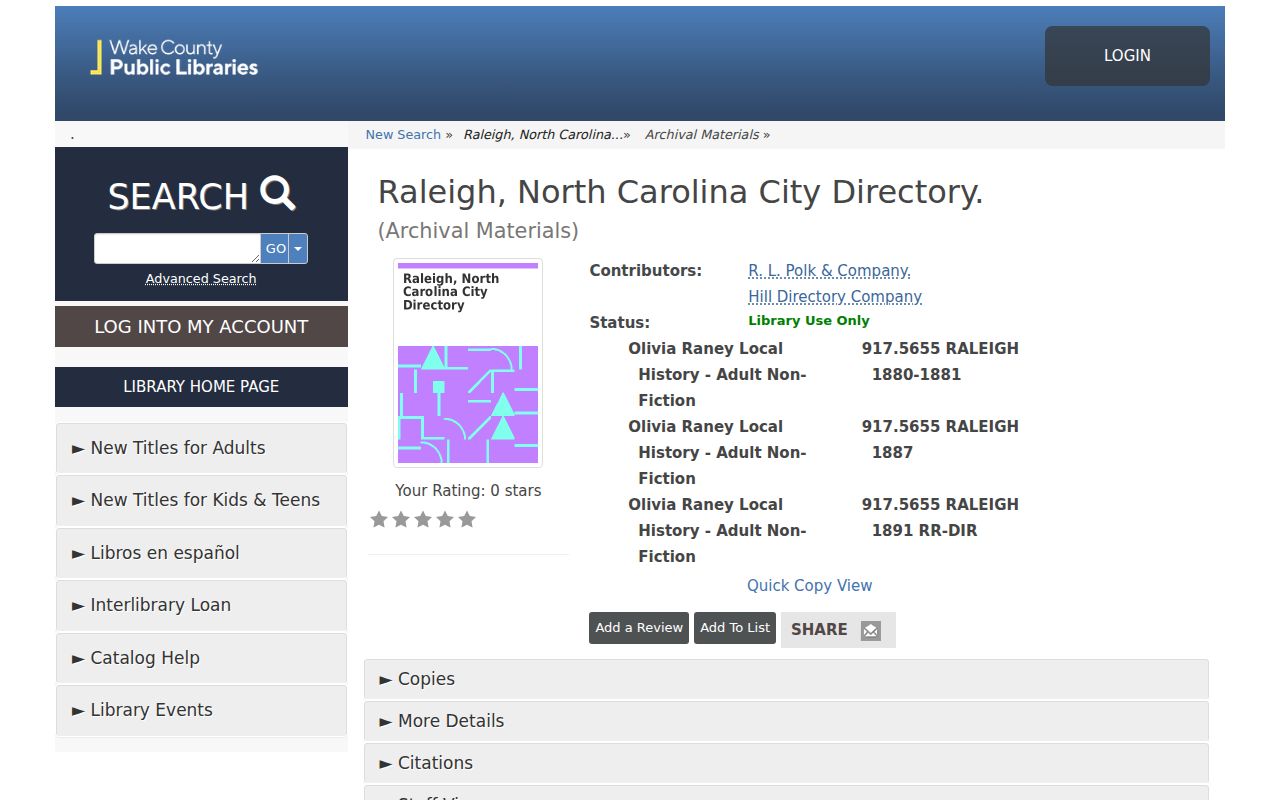
The catalog image reinforces why a year, title variant, and access condition should be recorded together when working through annual volumes.
Tracing Holly Springs Household Entries Across Years
Family-history work gains strength when the yearly directory is paired with a decennial census and a property trail. A directory gives movement, address, occupation, and local business context close to its reporting year. The census is a household snapshot with approximate ages and relationships. Neither was necessarily compiled on the same date. Use each for the kind of detail it actually records, then bridge a missing directory year with deeds, tax lists, newspapers, or library material.
- Choose the directory volume closest to the known surname or address.
- Record every printed field and photograph or note the abbreviation key.
- Check the criss-cross section for the address when that title provides one.
- Repeat in the closest earlier and later available volumes, allowing for catalog gaps.
- Pair the resulting timeline with the nearest available federal census and the relevant deed or tax record.
The available federal census reaches 1950 under the 72-year release rule cited in the research. A regional directory may omit Holly Springs even when the census and deed trail place a family in Wake County, so absence from one publisher's book is not a final answer.
Note: Directory canvass dates and census enumeration dates differ, so matching years should be treated as complementary, not simultaneous, evidence.
Holly Springs Records Beyond the Shelf
The State Archives lists the Cape Fear Enterprise as a Holly Springs weekly on one reel for 1899, 1900, and 1901. It is not a household listing, but death notices, marriage announcements, business advertising, community visits, school events, and address clues can test a directory lead. The town's railroad and crossroads history also explains why a person may be described by a village, post office, rural route, or nearby community rather than a modern street address.
Holly Springs history records a recovered early-1900s minutes book, a useful reminder that town history can identify records that ordinary online catalogs do not fully expose. The town history resource and the Wake County Historical Society provide local context, photographs, maps, publications, and project material, but they are not complete resident indexes.
The Wake County Historical Society documents the broader county preservation network that supports research around these regional volumes.
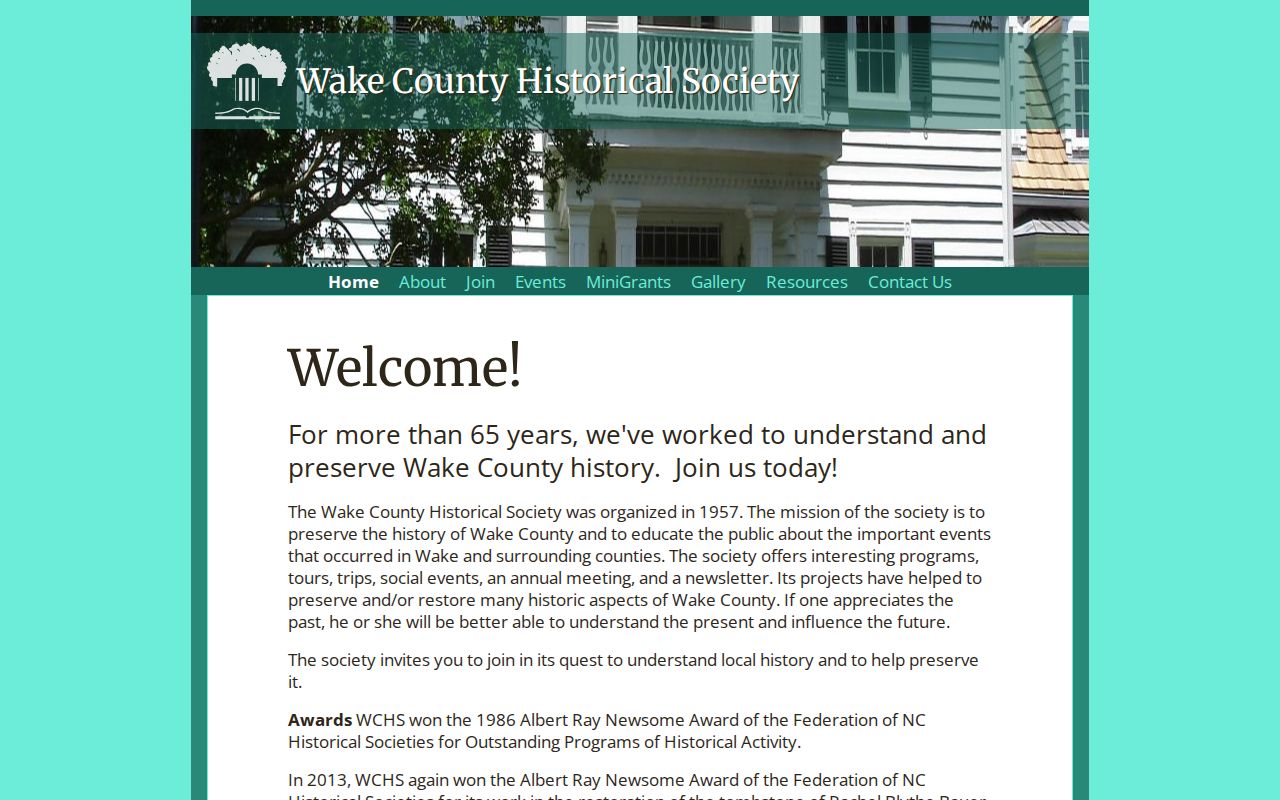
Its historical collections can add maps, clippings, and organizational records to a directory timeline without being mistaken for a searchable list of every resident.